

Depress ctrl and + keys together to increase text size; depress ctrl and – keys together to reduce
The Facebook thread reported in yesterday’s shake and bake, and other not entirely “normal” rumbas – Key West Paranormal Psychotherapy Institute post at goodmorningkeywest.com, sprouted a few more wings and feathers. So here is the whole schmele, followed by the Wisteria Island article mentioned in my last comment to WjamesBaldwin. It is Mr. Baldwin’s and my conversations, which are center stage today. So, if you wish, scroll down to there.


-
 Sloan Bashinsky Don’t know if it’s relevant to your and my discussion, but you mentioned September 11, so will say, during the night of September 9-10, 2001, in my sleep, a familiar voice asked me, “Will you make a prayer for Divine Intervention for all of humanity?” I woke up, wondering what that was about? I made the prayer. On September 11, I learned why I had been asked to make the prayer. I’m still wondering if the prayer was answered, and, if so, how it was, is, being answered?March 26
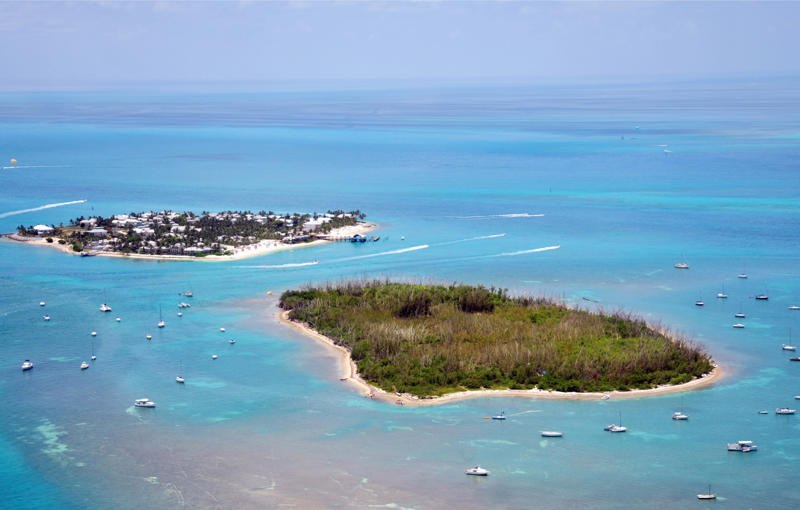
Wisteria Island, lower right, Sunset Key, upper left
Friday, March 27, 2015
Wisteria Island’s future uncertain
BY TIMOTHY O’HARA Citizen Staff
tohara@keysnews.com
Development will not come to Wisteria Island soon, if ever, because a federal judge has dismissed F.E.B. Corp’s lawsuit asking to be ruled as the owner of the 22-acre island.
Instead, Judge Jose E. Martinez issued a ruling Wednesday in favor of the Bureau of Land Management, which claimed government ownership of the island in Key West Harbor in 2011. The government made the claim after being presented with documents stating Florida could have not sold the island to its original owners decades ago, because the federal government never deeded the land to the state.
F.E.B. Corp sued the Bureau of Land Management shortly after it asserted ownership of the island.
While Judge Martinez technically did not rule specifically on the ownership issue, he did find that the statute of limitations on the case had run out in 1963 and the court no longer had jurisdiction in the case, which meant he could not rule in the matter. This means that the Bureau of Land Management’s 2011 claim the federal government owns the land will remain unchallenged.
Judge Martinez cited a Sept. 27, 1951, letter from then-Florida Attorney General Richard Ervin. The letter shows that the original owner, former Rep. Bernie Papy, was aware that the military was still claiming ownership of the island when he bought it from the state.
Ervin questioned whether the Navy, or any other federal agency, deeded the land to the state and whether the state can sell something it didn’t actually own. The attorney general “communicated his ambivalence regarding the Navy’s claim,” Martinez wrote.
Ervin was unable to state definitely whether or not the Navy’s claim is valid, but “the claim is debatable enough and so shrouded in antiquity that I think the best course would be for the (state) to complete the sale,” Ervin wrote.
“By the Attorney General’s own words, therefore, in 1951 there was a question of title regarding the subject property which needed to get settled,” Martinez wrote.
Martinez ruled that the 12-year statute of limitations on what is known as a Quiet Title Act started running with the 1951 letter.
“Because Plaintiff filed its suit more than 12 years after 1951 — the date its predecessor in interest, the State of Florida, received actual notice of the claim of the United States — the suit is barred by 28 U.S.C. j 2409, and this court has no jurisdiction to inquire into the merits,” Martinez wrote.
F.E.B. Corp. President Roger Bernstein, whose family bought the island in 1967, argued that the judge did not rule on the ownership at all or on the merits of the case. Bernstein did not rule out filing some kind of an appeal, he said Thursday.
“It’s not over,” Bernstein said. “We are evaluating our options. This decision is procedural.”
Bureau of Land Management based its ownership opinion in 2011 on three documents that show the federal government claimed ownership as early as 1845, then reserved it for the Navy’s use in 1924, then gave control of it to U.S. Fish and Wildlife, the U.S. Department of Treasury and the U.S. Department of the Interior in 1982, according to Frankie Morgan, a legal assistant for the Bureau of Land Management.
Since the 2011 ruling, refuge managers had continued to treat Wisteria Island as private property until the court case was resolved.
“No one has contacted me and I don’t know what the status is,” Nancy Finley, who oversees all of the Keys refuges for the U.S. Fish and Wildlife Service, said Thursday. “We have not talked about it a all since I have been here. We will wait to hear from the appropriate parties.”
The Bernstein family has been paying property taxes on the property since the 1967 purchase. The family, under the name F.E.B. Corp., has been working with Sunset Key’s owners to develop Wisteria Island.
While county records show the buyer was Paul E. Sawyer and his wife, Reta, other state and federal records show Sawyer, the Monroe County attorney at the time, was acting as an agent for Bernie C. Papy. The deed says the sales price was $2,769, but the document stamps show it was $6,100, and it is unclear which figure is correct.
On Jan. 28, 1952, just 19 days later, the Sawyers transferred the island to Papy and his wife, Pauline, for $6,100. Papy, a Key West real estate developer, was a 14-term member of the Florida House of Representatives.
In March 1956, the Papys sold it to Amaryk Aldo and his wife, Charlotte, for $115,500.
In April 1962, the Aldos spent $200 to transfer ownership to Wisteria Island Inc., whose principals were Aldo himself, acting as the company’s president, and Secretary Jack A. Davis.
In January 1967, Wisteria Island Inc. sold it for $317,750 to F.E.B. Corp., which in 1972 bought additional bay bottom from the state.
tohara@keysnews.com
A different kind of wild bird …

sloanbashinsky@outlook.com
