
Depress ctrl and + keys together to increase text size; depress ctrl and – keys together to reduce

Perhaps prompted by my favorable references to Jesus in yesterday’s One nation, under God – boast, or prayer for it to happen? And related be careful what you ask for parts of Sloan Bashinsky’s figleafless freaking fool campaign platform for President of the United States of America, reported at goodmorningkeywest.com post at goodmorningkeywest.com, Key West amiga Erika Biddle, a German transplant, dropped this jewel into my Facebook account yesterday:

spreading the Truth a bit today! XOE

This, my friends, is wonderful piece of Sunday writing. Well done, John Fugelsan
Syndicated article in today’s Key West Citizen (keysnews.com):
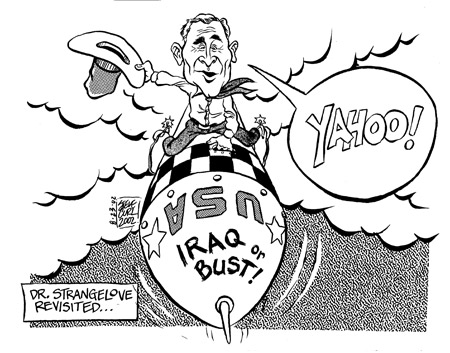
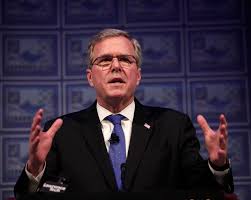
Jeb Bush says he wouldn’t have invaded Iraq
THE ASSOCIATED PRESS
TEMPE, Ariz. — After days of refusing to say whether, with the benefit of hindsight, he would have ordered the invasion of Iraq in 2003, Jeb Bush relented Thursday and said he would not have invaded.
“If we’re all supposed to answer hypothetical questions, knowing what we know now, what would you have done?” Bush said with a twinge of annoyance while campaigning in Arizona. “I would have not engaged. I would not have gone into Iraq.”
It was an answer the former Florida governor and likely Republican candidate for president had refused to give in several public appearances this week, even as most of his GOP rivals did so and criticized him for sidestepping the question.
Bush said Thursday his resistance was caused both by loyalty to his older brother, George W. Bush, who ordered the invasion as president, and to the families of those lost in the decade-long war.
“I don’t go out of my way to disagree with my brother,” Bush told a group of reporters when asked about the shift. “I am loyal to him.”
That loyalty could cast a shadow over Bush’s all-butcertain presidential bid, where his family name is both his strongest political asset and liability. He would become the third member of his family to serve as president should he follow his father and brother to the White House.

Hmmm.
How about Jeb’s loyalty to his country? As US President, loyalty to country trumps everything, doesn’t it? Well, Jeb also didn’t mention loyalty to God, which does trump everything, according to “one nation, under God”, in the US Pledge of Allegiance.
What a crock of Bush shit. All those dead, maimed, crippled and post traumatic stressed American Iraq vets, and their equally traumatized families. Probably minuscule, compared to the killed, maimed, crippled and post traumatic stressed Iraqi troops and civilians, and their equally traumatized families.
A war fabricated by George W. Bush, and his goons, for Iraq’s oil, and to get even with Saddam Hussein for trying to kill George’s father, the first President Bush, who had tried to kill Saddam, yes? Before that, Saddam and that Bush were buddies. Saddam and his troops were US allies against Iran and the Soviets. Saddam had no beef with the US. He asked the US Ambassador if America would have a problem with Iraq taking Kuwait?, and the Ambassador indicated there would be no problem. So, Saddam invaded Kuwait, and then felt he had been set up by his old friend, the first President Bush, former Director of the CIA.
About the same for G.W. Bush’s second war, in Afghanistan. But that was about the US and war contractor Halliburton, Vice President Dick Cheney’s company, gaining, via a gas pipe line (which didn’t happen, yet) through Afghanistan into the natural gas fields in the old southern Soviet Republics.
Splendid contrasts between a Christian President, G.W. Bush, and Jesus. Splendid.

Well, back to Jeb Bush.
Excerpt from a syndicated column in today’s Citizen:
Jeb Bush struggles to recover from a truly awful week
BY GAIL COLLINS
New York Times Columnist
Let’s discuss Jeb Bush’s terrible week. I’m really troubled by his awful performances, and I’m generally a person who takes bad news about politicians pretty well. For instance, a friend just sent me a story about the Texas agriculture commissioner’s vow to bring deep-fried foods back to school cafeterias. (”It’s not about French fries; it’s about freedom.”) I would classify this as interesting yet somehow not a shocking surprise.
But today we’re talking about Jeb Bush.
As a presidential hopeful, Bush’s most attractive feature was an aura of competence. Extremely boring competence, perhaps. Still, an apparent ability to get through the day without demonstrating truly scary ineptitude.
Then, about a week ago, The Washington Post reported that during a private meeting with rich Manhattan financiers, Bush announced that his most influential adviser on Middle Eastern matters was his brother George.
This was a surprise on many fronts. For one thing, Jeb had apparently missed the memo on how everything you say to potential donors at private meetings can wind up on an endless YouTube loop for all eternity.
Also, he had begun his all-but-announced campaign for the presidency with an “I’m my own man” sales pitch. Now he was saying, in effect, “Well, I can always ask my brother.”
Then, on Monday, Fox News aired an interview in which host Megyn Kelly asked Jeb whether “knowing what we know now” he would have authorized the invasion of Iraq. “I would have, and so would have Hillary Clinton, just to remind everybody,” Bush replied.
Now no one, including Hillary Clinton’s worst enemy in the entire world, thinks that if she could go back in time to 2002, knowing that the invasion of Iraq was going to be a total disaster and that she would lose the presidential nomination in 2008 to a guy who ran on that very issue, she would still have voted to authorize the use of force. So, obviously, Bush misheard the question, right?
Apparently not. He then went on: “I mean, so just for the news flash to the world if they’re trying to find places where there’s big space between me and my brother, this might not be one of those.”
We had now learned that: 1) Jeb Bush still thinks invading Iraq was a good idea; and 2) he has inherited more of the family syntax issues than we knew.
Fast-forward one day: “I interpreted the question wrong, I guess,” Bush told Sean Hannity in a radio interview. “I was talking about given what people knew then, would you have done it, rather than knowing what we know now. And knowing what we know now, you know, clearly there were mistakes.”
He still didn’t claim that he’d have done anything different than his brother had done. (”That’s a hypothetical.”) But he was really nailing down that business about mistakes.
In the same general area of US President, Jerry Weinstock, M.D., Psychiatry, replied to the Israel part of yesterday’s One nation, under God – boast, or prayer for it to happen? And related be careful what you ask for parts of Sloan Bashinsky’s figleafless freaking fool campaign platform for President of the United States of America, reported at goodmorningkeywest.com post at goodmorningkeywest.com:
the Zionist ‘s legally paid for their land —according to historical sources.-many -Jerry
I Googled, then sent to Jerry:

MILESTONES: 1945–1952
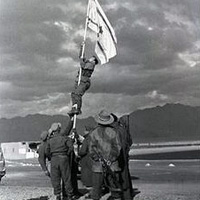
Creation of Israel, 1948
The Arab-Israeli War of 1948
Jewish land purchase in Palestine

Map showing Jewish-owned land as of 31 March 1945, including land owned in full, shared in undivided land and State Lands under concession. This constituted 6% of the total land area, of which more than half was held by the JNF and PICA[1]
Contents
[hide]
- 1 Background
- 2 Land purchases
- 3 Peel Commission
- 4 Economic impact
- 5 Influence on population
- 6 See also
- 7 References
- 8 Bibliography
- 9 External links
Background[edit]
Land purchases[edit]

KKL collection boxes to fund land purchases in Palestine were distributed in the diaspora from 1904

Jewish rabbis purchasing land from an Arab landowner, 1920s.

Anti-Zionist demonstration at Damascus Gate, March 8th, 1920
Peel Commission[edit]
A summary of land legislation enacted during the Civil Administration shows the efforts made to fulfill the Mandatory obligation in this matter. The Commission point to serious difficulties in connection with the legislation proposed by the Palestine Government for the protection of small owners. The Palestine Order in Council and, if necessary, the Mandate should be amended to permit of legislation empowering the High Commissioner to prohibit the transfer of land in any stated area to Jews, so that the obligation to safeguard the right and position of the Arabs may be carried out. Until survey and settlement are complete, the Commission would welcome the prohibition of the sale of isolated and comparatively small plots of land to Jews.[…]Up till now the Arab cultivator has benefited on the whole both from the work of the British Administration and the presence of Jews in the country, but the greatest care must now be exercised to see that in the event of further sales of land by Arabs to Jews the rights of any Arab tenants or cultivators are preserved. Thus, alienation of land should only be allowed where it is possible to replace extensive by intensive cultivation. In the hill districts there can be no expectation of finding accommodation for any large increase in the rural population. At present, and for many years to come, the Mandatory Power should not attempt to facilitate the close settlement of the Jews in the hill districts generally.The shortage of land is due less to purchase by Jews than to the increase in the Arab population. The Arab claims that the Jews have obtained too large a proportion of good land cannot be maintained. Much of the land now carrying orange groves was sand dunes or swamps and uncultivated when it was bought.Legislation vesting surface water in the High Commissioner is essential. An increase in staff and equipment for exploratory investigations with a view to increasing irrigation is recommended.
—Report of the Palestine Royal Commission - July 1937[11]
Economic impact[edit]
Influence on population[edit]
Jerry replied:
Thanks very informative and thorough.
After being egged on in dreams, I wrote to Jerry this morning:
As I had thought, the US was behind the creation of the state Israel. I recall reading somewhere, years ago, the US didn’t want the post-World War II Jewish refugees settling in the US, nor did the British want them settling in Great Britain, and that was behind the creation of the state Israel after WW II.
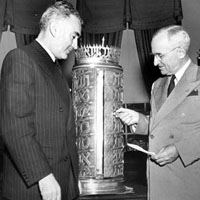
I know Truman was capable of being devious. Several years ago, some American national magazine, I think maybe it was Life, trying to be resurrected, published an excerpt from Truman’s handwritten diary, in which he wrote: he dropped the A-bombs on Japan to intimidate the Russians, the Japanese already were trying to surrender.
Truman’s predecessor, Roosevelt, was devious. He knew the Japanese were heading to attack Pearl Harbor and he deliberately did not warn the the Pacific Fleet, because he wanted the attack to occur, so American sentiment would turn toward America entering WW II against Germany and Japan, which were allies, with Italy, as I recall - The Axis Powers?
Harry Truman made a grave mistake when he recognized Israel in 1948. Now, whether America admits it, or ever admits it, America is at war with Islam, which sincerely views America as The Great Satan. Islam views itself as the one true religion, and all who do not join them are infidels, to be treated accordingly. Make no mistake, Saudi Arabia, for example, is covertly backing the Islamic jihadists against America, and is funding the jihadists with money America pays for Saudi oil. It’s going to be a really, long, very bad time ahead for America, and for the world, against Islam. And it’s going to be a lot worse for America, if it keeps helping Israel.
America’s next President needs to cut America’s tie with Israel and withdraw all US military personnel and civilian contractors, and spies, and embassies, from all Islam countries - ALL. America is way past needing to take a really hard look in the mirror, and then get to work on that jihad, which is the true jihad - the inside war, with self; a war that might take America decades to wage, before any good comes from it outwardly; and even then it may be too late for America, as you and I know it.
I see one candidate for US President who comprehends what America needs to do. Me. The other candidates are clueless. As is President Obama. If he had taken the Nobel Peace Prize to heart, he quickly would have ended the Iraq and Afghanistan wars, and cut off Israel, and gotten the US out of the Middle East. Too bad he didn’t live up to his 2008 campaign mantra: hope, change. And his promises to end those two Bush wars. Too bad.

And too bad President Obama didn’t stick with his longtime friend, Christian minister and adviser Jeremiah Wright, who sees America good enough.

In 1998, a very dear friend of mine, who was Jewish and being turned every which a way but loose by the angels (Jesus, Michael and Magdalene Melchizedek), told me they told him the Holocaust and the Diaspora were karma for the Palestine Jews in Jesus’ time rejecting his teachings, which I summarized in yesterday’s post at goodmorningkeywest.com, to which you responded that the Zionists had purchased the Palestine land.
Not entirely aside, after I pedaled my bicycle from Sippin’ Internet Cafe on Duval Street to the county jail on stock island yesterday, about 5 miles, into the wind, to visit my lady Kari, Thursday is the only week day the visitation hours work for me to see her, I was told by a deputy that the elevator in the jail was broken and visitation was canceled for the day. Pedaling my bicycle back toward Duval Street, I understood it was a demonic attack for what I was posting at goodmorningkeywest.com, and I was the cause of jail inmates and their relatives and friends not getting to visit yesterday, and I did not like knowing that.
About that time, Kari called me from the jail, to let me know what was going on about no visitation, and I told her why it had happened and I felt terrible about it. When she called me last night, she said some inmates’ visitors had driven all the way down from the mainland, and I said I felt even worse. She did not say I was nuts. It was a demonic attack. I have seen it many times because of stuff I am doing. Many times.
It won’t surprise me if the angels geographically relocate me away from the Florida Keys. If I leave, who will do the spiritual warfare, the heavy lifting, I have been doing here since the angels brought me here in late 2000? Who will take on the demonic entities I engage though their human proxies, who, for the most part, are totally unaware of what has them in its grip? Maybe no one will take my place here. The people who were selected by the angels to do that thankless work here, went at it half-hearted, or turned away. The allures of this world, money, being liked, familiar routines, convenience, narcotics, were too important to them and the rigor of the spiritual warfare was more than they wanted as steady diet.
Sloan


moi and my running mate Kari
sloanbashinsky@outlook.com
